
Aurora Criminal History Checks
Start with the custodian closest to the event. Aurora Police holds incident, arrest, dispatch, and evidence records. Aurora Municipal Court controls city-code and city-traffic cases. The city detention center answers short-term custody questions, while a county jail may hold someone after transfer. State charges belong to the court where prosecutors filed them.
- Identify the incident site, arresting agency, and any report or summons number.
- Use APD NextRequest or form APD 057 for the needed police product.
- Search Aurora's docket by name or summons number.
- Check the proper county court and jail if the matter moved beyond Aurora.
- Use CBI ICHC for a statewide layer, then verify the disposition with the court.
These sources answer different questions. A police file documents the investigation. A docket indexes hearings. A jail entry describes custody. The court file establishes filed charges and outcomes. CBI compiles fingerprint-supported Colorado arrest cycles and reported dispositions, but may omit a summons or an outcome not yet sent to the repository.
When a name search returns nothing, check spelling, prior names, birth date, and the record's likely age before changing offices. Then confirm whether the event was an Aurora municipal matter or a state case. The city docket excludes juveniles, and sealed records are not public. A negative result from one Aurora channel cannot rule out a record held by another custodian. Keep the report number, summons number, booking number, and court case number separate because each office indexes its own file.
Two Aurora Police Record Routes
APD's official records page routes detailed CCJRA requests through NextRequest. It covers body-camera video, third-party footage, crime-scene photos, 911 or radio audio, internal records, and custom statistics. Enter an Aurora number in the AP202212345 or 2022-12345 format exactly when known.
Form APD 057 offers a defined menu: Arrest History/Record, arrest or booking photo, address history, CAD or dispatch notes, person contact history, full report, summons only, and certification. Arrest history needs a name and birth date. Activity before 1996 also needs dates and charges because older Aurora files are less searchable.
| Channel | Best use | Key detail |
|---|---|---|
| NextRequest | CCJRA records and digital evidence | Use the exact AP case format |
| APD 057 | Defined reports and histories | Name and birth date for arrest history |
| Lobby | In-person help | 15001 E Alameda Parkway |
Records at the Aurora Police Department
APD creates the first Aurora criminal record when officers document a call, contact, suspected offense, summons, or arrest. Its file may contain the narrative, involved-person data, dispatch notes, and releasable evidence. It does not establish the final court disposition. Aurora routes police activity records, criminal reports, 911 recordings, arrest records, and officer-made crash reports to APD, but directs court outcomes to the court.
The headquarters records lobby is at 15001 E Alameda Parkway and operates from 8 a.m. to 5:45 p.m. daily. After-hours nonemergency help is 303-627-3100. A sound request gives the date, time, location, case number if known, and involved person's details. Name the desired evidence because review, redaction, blurring, or audio editing can affect release.
The official headquarters source provides the Aurora police image below.
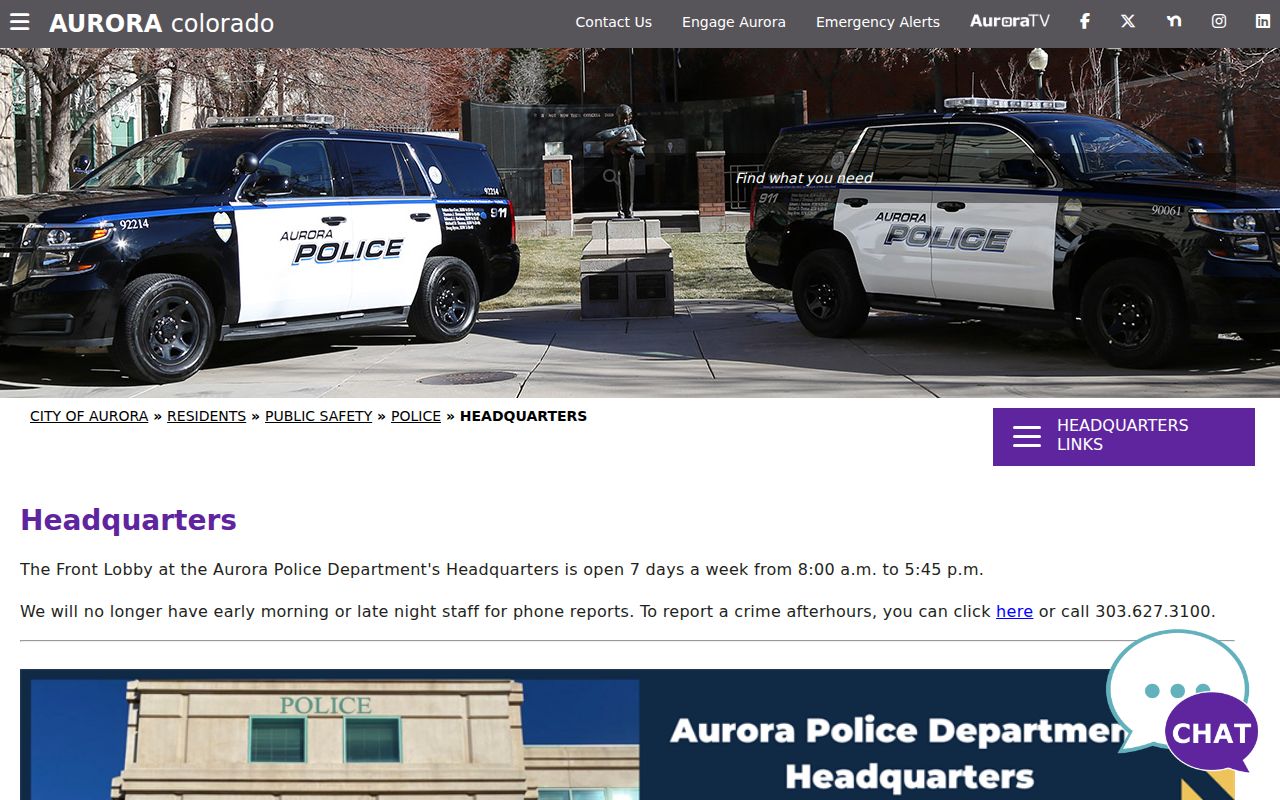
This is the police-record counter, not the clerk for municipal or county court documents.
Search the Aurora Court Docket
The Aurora Municipal Court docket accepts first and last name or summons number. It is free and excludes juvenile cases. A no-result may mean the case is juvenile, entered under other data, filed in state court, or not yet posted. It does not prove no police contact occurred.
The court hears Aurora code and traffic matters plus parks, neighborhood, truck, animal, and fire cases. Case help is 303-739-6444; scheduling is 303-739-6456; transcripts are handled at 303-739-6573.
The official docket source is shown in this Aurora search image.
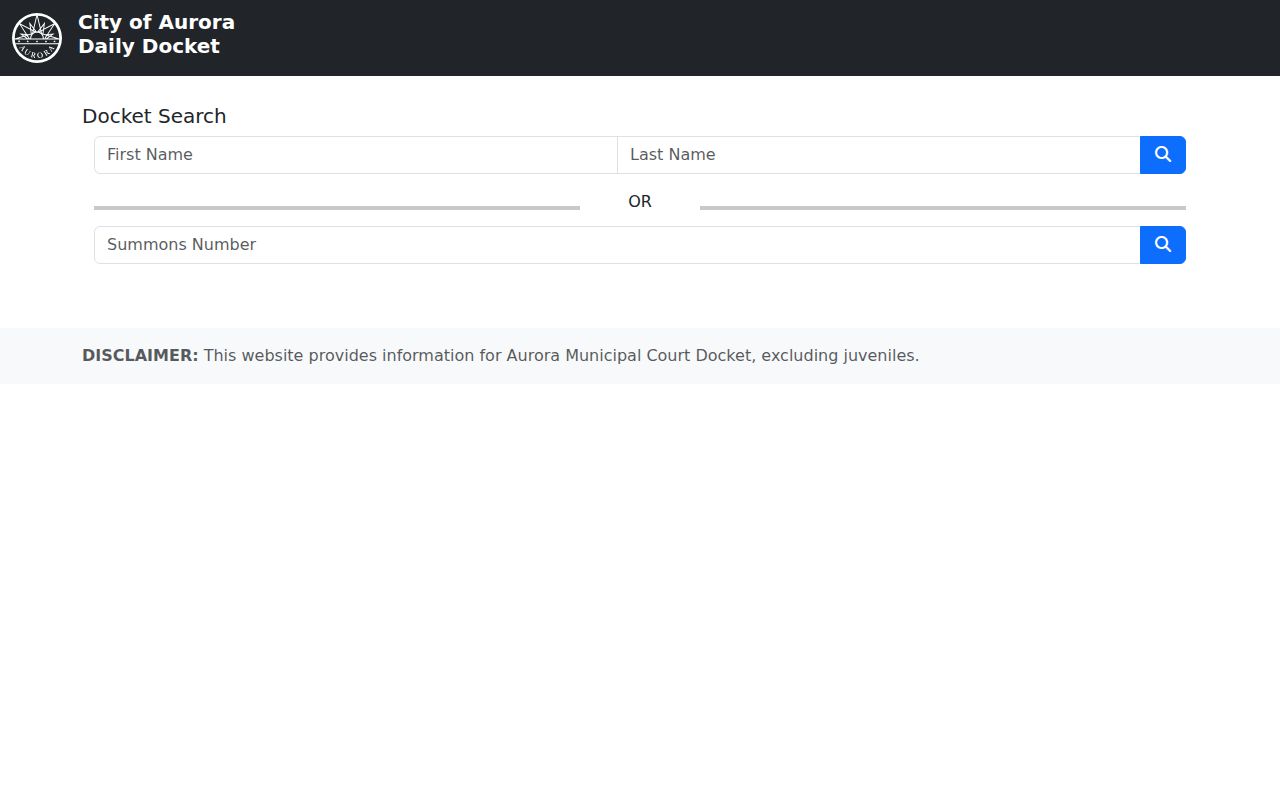
Name and summons searches point to city proceedings; state cases require Colorado Judicial Branch channels.
Booking and Arrest Records in Aurora
A recent Aurora arrest may begin at the city's 72-hour adult detention facility. It has a maximum capacity of 220 and coordinates with APD, city marshals, Arapahoe and Adams facilities, and other jurisdictions. Custody can change fast. A person held through an Aurora channel may later appear in a county jail after transfer.
Trace the report through APD, then identify the holding agency. County-filed charges and longer detention may move beyond Aurora. Because Aurora crosses Arapahoe, Adams, and Douglas counties, use the arrest location, agency, and court. The broader Arapahoe County arrest search explains that county layer.
APD cautions that investigative facts can change, probable-cause arrests may not lead to charges, and each person is presumed innocent. An Aurora arrest is not a conviction.
Verify an Aurora Municipal Warrant
Aurora provides three warrant checks: its online municipal channel, the counter at 14999 E Alameda Parkway, and 303-739-6455. Case staff answer 303-739-6444. These routes cover Aurora Municipal Court warrants, not District or County Court warrants.
A bench warrant may follow failure to appear or comply and is enforceable statewide. Aurora offers an in-court clearance process at 1:30 p.m. weekdays except holidays. A default traffic judgment is not the same as a warrant. A motion to set aside ordinarily should be filed within ten days, while later relief may require prosecutor approval. Confirm status before choosing the process.
The Aurora Municipal Court File
The court at 14999 E Alameda Parkway keeps city proceedings apart from APD investigations. Its record can show summons data, docket activity, hearing dates, orders, judgment, and releasable documents. Ask the court for the disposition rather than expecting APD to certify how prosecution ended.
| Court Name | Aurora Municipal Court |
|---|---|
| Case Types | City code, traffic, parks, neighborhood, truck, animal, and fire matters |
| Lookup | Online docket, counter, or 303-739-6444 |
| Search Fields | First and last name, or summons number; juveniles excluded |
| Other Contacts | Warrants 303-739-6455; transcripts 303-739-6573 |
Aurora probation and marshal records have their own city contacts. Court probation uses 303-739-6488, and the marshal can be reached at 303-739-6470.
Missing Aurora Crash Records
The custodian depends on who prepared the report. An officer-made crash report is available through APD's vendor for $10. Search with an involved person's last name and crash date; a report number speeds matching. A self-filed online crash belongs to the Colorado Department of Revenue instead. DOR assistance is 303-205-5600.
This split models Aurora record custody. The office that creates a document controls it. A self-filed crash sent to APD, a police disposition request sent to APD, or a state case request sent to Aurora Municipal Court can return no result even though a valid file exists elsewhere.
How Aurora Records Reach the County
APD keeps the police record, but a state prosecution creates a separate court file. Prosecutors choose filed allegations. The court records hearings, orders, disposition, and sentence. Fingerprint-supported arrest cycles and received outcomes may later reach CBI.
Record flow: Aurora Police Department › proper county court › Colorado Bureau of Investigation
Recent activity is clearest at APD, the city court, or current custodian. ICHC is a later summary layer, not a substitute for original files. Check a missing disposition with the deciding court and submit official correction documents to CBI when needed.
Filter Aurora Crime Record Trends
Aurora's dashboard covers five years and filters reported activity by year, district, ward, beat, ZIP, neighborhood, and category. APD reported motor-vehicle theft falling from 6,801 reports in 2022 to 2,059 in 2025. Through April 12, 2026, reports totaled 3,044 versus 3,655 at the same point in 2025. These are dated city counts, not a person's criminal history.
The April 2026 APD release supplies the snapshot shown below.
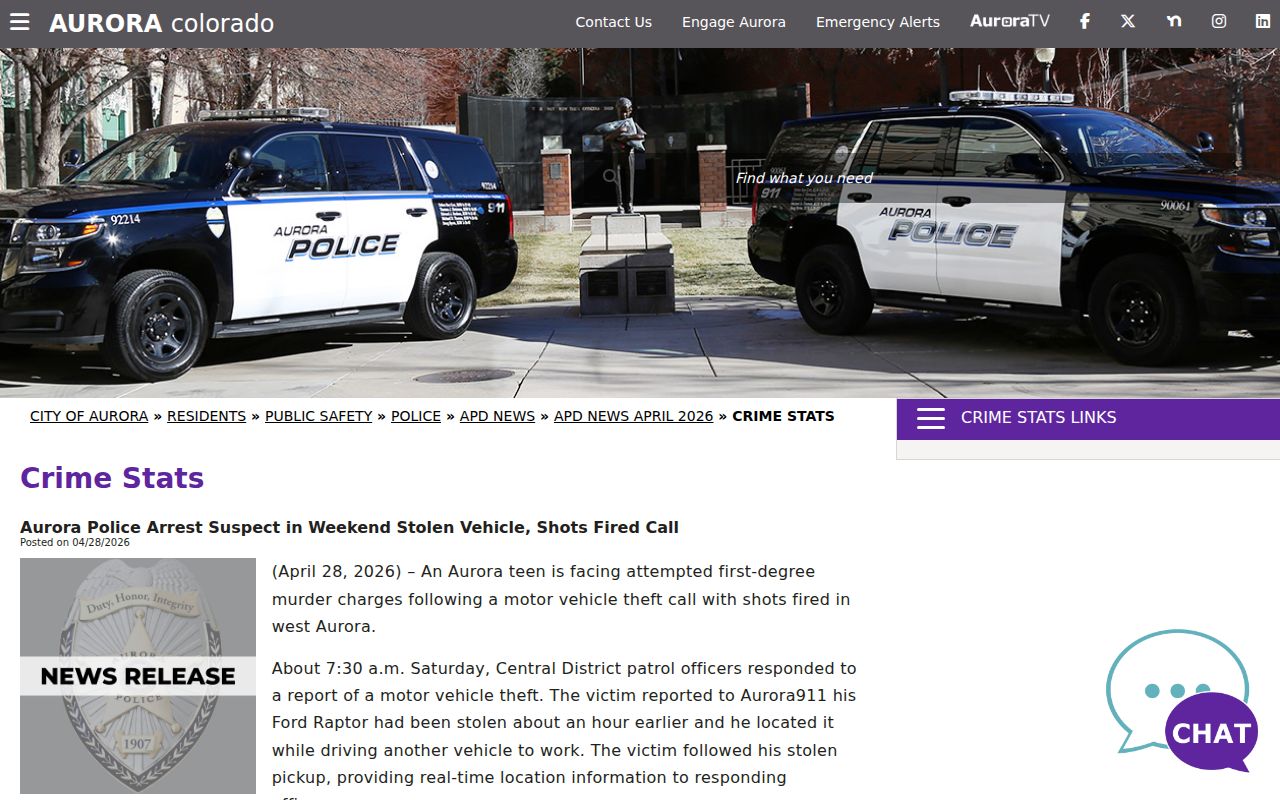
Trend data supplies context. It cannot establish whether a named person was charged or convicted.
Aurora Records Cross Three Counties
Aurora grew from Fletcher, incorporated in 1891 with 39 residents, into more than 165 square miles and over 450 neighborhoods. It became Aurora in 1907 and a city in 1928. Later growth tied to Lowry, Fitzsimons, and Buckley pushed the city across Arapahoe, Adams, and Douglas counties.
That geography changes the search order. Start with the location of the event, the arresting agency, and the court named on the summons or case notice. An Aurora Police report stays with APD, but a state charge may be filed in the county where the conduct occurred. Short-term detention at the city facility can also be followed by transfer to a county jail. The word "Aurora" in an address is therefore not enough to select an Arapahoe County custodian. Confirm the county boundary and issuing court before requesting a disposition, warrant record, or older custody file.
An Aurora address therefore does not identify the right state court or jail. Confirm the event site, acting agency, and court shown on the summons. Municipal Court stays the city channel, while a state case follows the county tied to filing.
Aurora Record Access Rules
Colorado separates general public records from criminal-justice records. CORA governs ordinary city material; CCJRA governs Aurora police files. A custodian may restrict release due to statute, court order, privacy, public interest, or an active investigation. Juvenile and sealed matters do not become public because a requester knows a name.
Key Statutes:
CCJRA, CRS 24-72-301 through 309 governs Aurora criminal-justice records.
CRS 24-72-305 permits restrictions for specified records.
CRS 24-72-305.5 bars release for direct business solicitation.
Use Aurora's specific police process for CCJRA material. Use the court for dispositions and certified court documents. Fees may reflect actual search, retrieval, review, redaction, and copying work allowed by law.